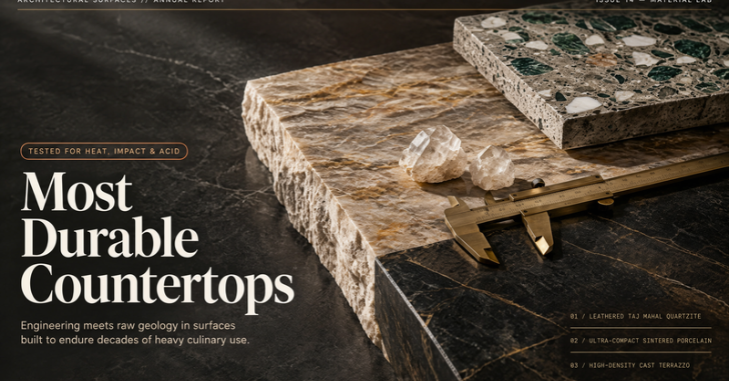
Choosing the most durable countertops means looking beyond hardness alone. Heat, scratches, stains, impact damage, and maintenance all affect how well a surface ages. For most U.S. kitchens, porcelain, quartzite, quartz, and granite form the strongest shortlist.
Quick answer: Porcelain offers exceptional heat, stain, scratch, and UV resistance with almost no routine maintenance. Quartzite is harder and highly heat resistant, while quartz excels against everyday stains. Granite remains a dependable natural-stone choice for homeowners who value heat resistance, longevity, and broad availability.
Countertop Durability at a Glance
| Material | Scratch Resistance | Heat Resistance | Stain Resistance | Maintenance | Best Fit |
|---|---|---|---|---|---|
| Porcelain | Excellent | Excellent | Excellent | Very low | Busy kitchens and sunny spaces |
| Quartzite | Excellent | Excellent | Very good | Moderate | Heavy cooking and natural-stone buyers |
| Quartz | Excellent | Good | Excellent | Very low | Families wanting easy care |
| Granite | Very good | Excellent | Good to very good | Low to moderate | Long-lasting traditional kitchens |
| Stainless steel | Fair visually | Excellent | Excellent | Low | Serious cooks and modern kitchens |
| Soapstone | Fair | Excellent | Excellent | Low | Heat-heavy kitchens |
| Solid surface | Fair | Fair | Very good | Low | Repairability and joint-free designs |
| Laminate | Fair | Fair | Good | Very low | Budget-conscious remodels |
Consumer Reports evaluates counter materials against stains, abrasion, cutting, heat, and impact. Those categories give homeowners a better durability picture than hardness alone. No single surface leads every category.
How We Ranked the Most Durable Countertops
A most durable countertop is a long-lasting work surface that needs to survive several different types of damage. Scratch resistance matters around knives, dishes, and small appliances. Heat resistance becomes critical near ranges, ovens, and countertop cooking equipment.
Stain resistance matters because coffee, oil, tomato sauce, wine, and other liquids appear regularly in kitchens. Impact resistance also matters around exposed edges and sink cutouts. Maintenance requirements determine how easily the material keeps its protection over time.
We ranked these materials by balancing all those factors rather than rewarding hardness alone. That approach explains why different materials can win for different households. The strongest choice matches the risks created by your cooking habits.
1. Porcelain: Best All-Around for Low-Maintenance Durability
Porcelain is one of the strongest choices for homeowners who want minimal upkeep. It resists heat, scratches, stains, and sunlight exceptionally well. Its dense surface also eliminates the need for routine sealing.
Recent durability comparisons place porcelain among the strongest all-around performers. Its main weakness is edge impact because thin slabs can chip when struck hard. Skilled fabrication therefore matters around corners, sinks, and cooktop openings.
Pros
- Excellent heat resistance.
- Excellent stain resistance.
- Strong scratch resistance.
- No routine sealing.
- Suitable for bright or outdoor spaces.
Cons
- Edges can chip from hard impacts.
- Fabrication requires experienced installers.
- Repairs can be difficult to disguise.
- Premium products can cost more.
Porcelain works especially well for active households that cook frequently. It also suits kitchens receiving substantial direct sunlight. Use cutting boards and reasonable edge protection despite its strong surface performance.
2. Quartzite: Best Natural Stone for Heavy Kitchen Use
Quartzite combines natural stone appearance with exceptional hardness. It handles scratches and cooking heat better than many decorative stones. Its natural veining also appeals to homeowners who like marble-style movement.
Many durability comparisons place quartzite near the top for scratch resistance. It also performs strongly around heat because it lacks the resin found in engineered quartz. Periodic sealing helps reduce liquid absorption and staining.
Pros
- Excellent scratch resistance.
- Excellent heat resistance.
- Natural stone appearance.
- Strong long-term durability.
- Good UV stability.
Cons
- Usually needs sealing.
- Slabs vary naturally.
- Fabrication can be expensive.
- Some products are incorrectly labeled in the marketplace.
Ask your fabricator exactly what stone you are buying before approving a slab. True quartzite should not be confused with similarly named engineered products. Inspect the actual slab whenever color consistency matters.
3. Quartz: Best for Everyday Stain Resistance
Engineered quartz remains popular because daily care is simple. Its nonporous surface resists common spills without requiring periodic sealing. It also offers consistent patterns that simplify matching across larger kitchens.
Quartz performs strongly against scratches and stains during normal residential use. Heat remains its important limitation because polymer resins can suffer thermal damage. Manufacturers commonly recommend trivets or hot pads beneath heated cookware.
Pros
- Excellent stain resistance.
- Strong scratch resistance.
- No sealing required.
- Consistent color options.
- Easy everyday cleaning.
Cons
- Less heat tolerant than stone or porcelain.
- Edges can chip.
- Direct sunlight can affect some products.
- Heat damage can be difficult to repair.
Choose quartz when spills and low maintenance matter more than extreme heat tolerance. Keep trivets near cooking zones so protecting the surface becomes automatic. Always follow the specific manufacturer’s care instructions.
4. Granite: Best Proven Natural-Stone All-Rounder
Granite has decades of use behind its reputation for toughness. It handles abrasion, scratches, and kitchen heat exceptionally well for a natural material. Each slab also provides unique color and mineral variation.
The Natural Stone Institute describes granite as suitable for heavily used surfaces. It reports strong abrasion resistance and typical heat resistance around 480°F. Localized heat should still be avoided because rapid temperature differences can contribute to cracking.
Pros
- Excellent heat resistance.
- Strong scratch resistance.
- Long service life.
- Wide range of natural patterns.
- Broad U.S. availability.
Cons
- Some slabs benefit from sealing.
- Edges may chip after hard impacts.
- Natural patterns vary.
- Heavy slabs require proper support.
Not every granite slab requires the same sealing schedule. The Natural Stone Institute says many granites are already highly moisture resistant. Test your specific stone rather than sealing automatically on a fixed calendar.
AHomeGuru also explains how to handle marks and spills in its granite stain-removal guide. That guide can help homeowners protect an existing installation. Proper cleaning often matters as much as the material choice.
5. Stainless Steel: Best for Serious Cooking
Stainless steel has earned its place in professional kitchens for practical reasons. It tolerates heat and does not absorb household spills. Water and normal kitchen acids also cannot etch it like certain stones.
The surface will scratch during use, and those scratches remain visible. Many owners eventually accept the resulting patina as part of the material. Dents can also appear after strong impacts on lighter-gauge installations.
Pros
- Excellent heat resistance.
- Nonporous surface.
- Easy sanitation.
- No sealing.
- Works well around sinks and ranges.
Cons
- Shows scratches.
- Shows fingerprints.
- Can dent.
- Creates an industrial appearance.
This material makes sense when function matters more than a flawless decorative finish. It pairs particularly well with commercial-style appliances. Homeowners seeking traditional warmth may prefer natural stone instead.
6. Soapstone: Best for Heat and Chemical Resistance
Soapstone handles heat exceptionally well and resists many household chemicals. Its dense nature also helps prevent common staining problems. Unlike granite, it generally does not require a penetrating sealer.
Its weakness is softness rather than structural durability. Knives, cookware, or dragged objects can leave marks more easily than on quartzite. Small scratches can often be sanded or blended into the developing patina.
Pros
- Excellent heat resistance.
- Strong stain resistance.
- No conventional sealing requirement.
- Natural appearance.
- Minor marks can often be blended.
Cons
- Scratches relatively easily.
- Limited color range.
- Develops a patina.
- Availability varies by region.
Soapstone works best for homeowners comfortable with visible aging. It rewards people who value repairability over a permanently pristine appearance. Its heat tolerance makes it especially practical near cooking areas.
7. Solid Surface: Best When Repairability Matters
Solid-surface materials offer a different definition of durability. They scratch more easily than stone but can often be sanded and repaired. Seamless fabrication also reduces dirt-catching joints around sinks and backsplashes.
Heat protection remains necessary because high temperatures can damage the material. Deep cuts and impacts can also require professional repairs. Daily stains are usually easier to manage because the surface is nonporous.
Pros
- Repairable surface.
- Nonporous.
- Seamless installation options.
- Many colors available.
- Easy routine cleaning.
Cons
- Lower scratch resistance.
- Limited heat resistance.
- Can show wear.
- Less natural variation.
Solid surface is a practical choice for homeowners who prioritize renewal. Damage does not always mean replacement. That can make it attractive for kitchens expected to receive heavy family use.
8. Laminate: Best Durable Choice on a Tight Budget
Laminate costs less than most slab materials and handles everyday spills reasonably well. Modern products also offer convincing stone, wood, and concrete patterns. Routine cleaning is simple because sealing is unnecessary.
Heat and sharp objects create the biggest risks. A damaged top layer cannot be refinished like natural wood or some solid-surface products. Water intrusion around damaged seams can also shorten its service life.
Pros
- Lower purchase cost.
- Good stain resistance.
- Easy cleaning.
- Large style selection.
- No sealing.
Cons
- Lower heat resistance.
- Can scratch or chip.
- Difficult to repair invisibly.
- Vulnerable around damaged seams.
Laminate still makes sense for rentals, starter homes, and budget remodels. Protect it with cutting boards and trivets from the first day. Careful use can extend its useful life considerably.
Which Material Should You Choose?
For maximum all-around performance with minimal upkeep, porcelain is our top recommendation. It handles the widest mix of common kitchen threats without routine sealing. Protecting exposed edges remains its main durability consideration.
Choose quartzite when natural stone and extreme scratch resistance matter most. Choose quartz when stains and easy maintenance dominate your priorities. Granite remains an excellent choice when heat resistance, natural variation, and proven longevity matter.
Your kitchen design should also influence the decision. Counter color interacts with cabinets, wall finishes, flooring, and backsplash materials. Browse AHomeGuru’s kitchen design section before finalizing the complete palette.
Homeowners planning a farmhouse-style space can also compare finishes with AHomeGuru’s shiplap kitchen backsplash ideas. A surface should complement nearby materials without sacrificing practical needs. Decide on performance first, then narrow the color and finish.
How to Make Any Counter Last Longer
Even tough materials benefit from basic protection. Use a cutting board rather than cutting directly on the work surface. Place trivets under hot pans even when the material has strong heat resistance.
Clean spills quickly, especially on natural stone. Follow product-specific recommendations for cleaners, sealers, and abrasive tools. Avoid assuming one cleaning method works for every material.
Protect exposed corners from heavy cast-iron cookware and appliances. Edge damage is one of the few weaknesses shared by several otherwise tough materials. Good fabrication and thoughtful edge profiles can reduce that risk.
Final Verdict
Durability means choosing the material that survives your household’s most common risks. Porcelain provides the strongest all-around balance for many U.S. homeowners. Quartzite, quartz, and granite remain excellent alternatives with different strengths.
Before ordering, compare full-size slabs or samples under your kitchen lighting. Ask fabricators about edge protection, seams, warranties, support, and care requirements. The right installation can matter almost as much as the material itself.
Frequently Asked Questions
What are the most durable countertops for a busy kitchen?
The most durable countertops include porcelain, quartzite, quartz, and granite. Porcelain provides the strongest balance of heat, scratch, stain, and UV resistance. Quartzite is especially attractive when natural stone and high scratch resistance matter.
Is quartz or granite more durable?
Quartz performs better against routine staining and does not need sealing. Granite handles high cooking temperatures better and offers excellent scratch resistance. Your cooking habits should decide which advantage matters more.
What countertop requires the least maintenance?
Porcelain and quartz are among the easiest materials to maintain. Neither normally requires routine sealing, and both resist everyday stains. Porcelain adds stronger heat and UV performance.
Which countertop handles hot pans best?
Porcelain, quartzite, granite, soapstone, and stainless steel all offer strong heat resistance. Manufacturers still recommend sensible heat protection for many installed surfaces. Using trivets reduces thermal-shock risks and protects surrounding finishes.
What durable material works best on a smaller budget?
Granite can offer strong value where common colors are competitively priced locally. Laminate costs less but sacrifices scratch and heat resistance. Compare installed quotes rather than material prices alone.
Which counter surface resists scratches best?
Quartzite and porcelain are among the strongest choices against normal scratching. Granite and engineered quartz also perform well in active kitchens. Cutting boards remain worthwhile because they protect both the surface and your knives.