Choosing among solar companies is less about finding one national winner and more about finding the right installer for your home. Pricing, service areas, equipment, warranties, financing, and local crews can differ greatly between providers. Comparing several qualified installers before signing a contract gives you a stronger basis for choosing.
The U.S. residential market has also changed since earlier buying guides were published. The federal Residential Clean Energy Credit ended for expenditures made after December 31, 2025. Homeowners shopping in 2026 should therefore calculate costs using current state, utility, and local incentives instead of assuming a federal 30% credit.
Solar Installer Comparison at a Glance
| Provider | Good fit for | Notable strength | Main point to check |
|---|---|---|---|
| Sunrun | Homeowners considering subscriptions or batteries | Large residential presence and storage options | Contract terms and local availability |
| Tesla Energy | Buyers interested in Tesla panels and Powerwall | Integrated hardware and app | Local installation and service availability |
| Palmetto | Buyers comparing ownership and subscription models | Multiple payment approaches | Exact equipment and local installer arrangements |
| Blue Raven Solar | Buyers seeking another national or regional quote | Established residential focus | Current ZIP-code coverage and financing terms |
| Momentum Solar | Homeowners in covered states wanting guided service | Regional market presence | Availability, warranties, and local crew details |
Direct answer: The right provider should offer competitive pricing, suitable equipment, clear warranties, licensed installation, and dependable post-installation support. Compare at least three written quotes using the same system size, financing assumptions, equipment specifications, and estimated production before deciding.
5 Solar Companies U.S. Homeowners May Want to Compare
1. Sunrun
Sunrun remains one of the most visible residential providers in the country. Its offerings emphasize home energy systems, battery storage, and several ownership or service arrangements. The company also promotes long-term system protection under eligible plans.
Sunrun can make sense for homeowners who prefer a service-based approach instead of paying the full system cost upfront. Battery availability and specific plan terms can vary by location. Ask for the cash price and total contract cost before comparing its proposal with competing bids.
Pros
- Large residential customer base.
- Battery options in qualifying markets.
- Multiple payment structures.
- Long-term service programs on eligible plans.
Cons
- Products and terms can differ by market.
- Long contracts require careful review.
- A subscription may cost more long term than ownership.
2. Tesla Energy
Tesla offers rooftop panels, battery storage, monitoring, and energy controls through its connected energy ecosystem. The company says it has deployed more than 500,000 U.S. systems. Its current panels also carry a 25-year product and performance guarantee.
This option can appeal to homeowners who already use Tesla products or specifically want Powerwall storage. Its digital buying process can also suit shoppers who prefer fewer traditional sales meetings. Confirm who will install and service your system locally before placing an order.
Pros
- Strong panel and battery integration.
- 25-year panel warranty.
- App-based system monitoring.
- In-house or certified installer network.
Cons
- Service experience can depend on location.
- Equipment choices are less open-ended.
- Buyers should verify project timelines locally.
3. Palmetto
Palmetto provides both purchase and subscription approaches for residential installations. Its current product information lists cash, loan, and 25-year subscription choices. The company also states that installed panels include 25-year product and linear performance protection.
Palmetto may suit homeowners who want several payment models from one provider. Equipment can vary according to the project and location, so review each proposed component. Request model numbers for panels, inverters, batteries, and monitoring hardware before signing.
Pros
- Cash, loan, and subscription choices.
- Long panel warranty.
- Access to different equipment manufacturers.
- Digital tools for estimating a project.
Cons
- Service is not available everywhere.
- Exact hardware varies by project.
- Financing costs require close comparison.
4. Blue Raven Solar
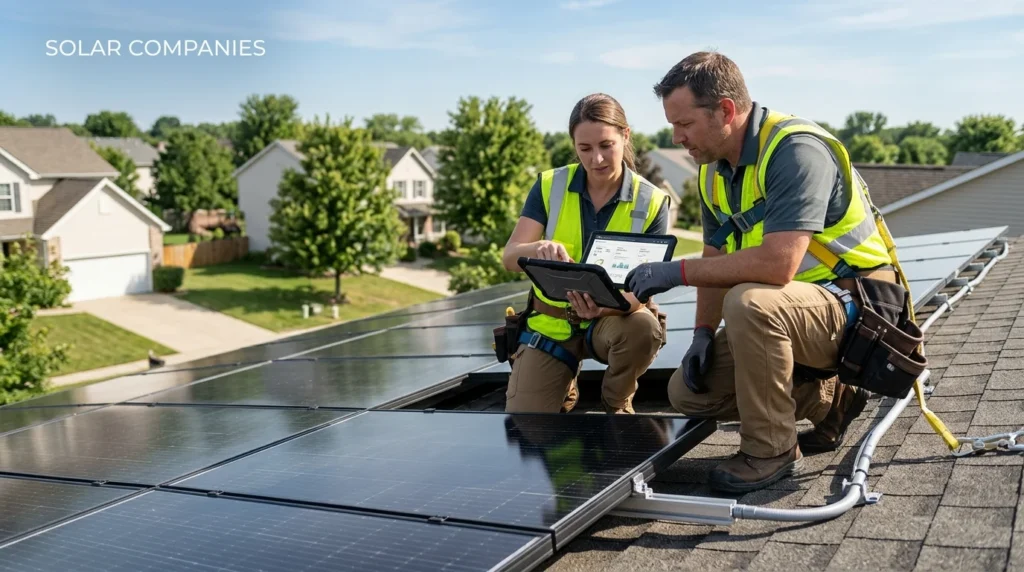
Blue Raven is another name worth checking when it operates in your area. Recent national comparison guides continue to include the brand among major residential installation choices. Availability should still be verified using your property address because service footprints change over time.
Treat its proposal like any other bid instead of choosing by brand recognition alone. Compare cash pricing, financed pricing, equipment, annual production estimates, and workmanship protection. Local customer reviews can also reveal how the installation and service teams perform in your market.
Pros
- Recognizable residential installer.
- Useful additional quote in covered markets.
- Residential-focused sales and installation model.
Cons
- Coverage is not universal.
- Financing terms need individual review.
- Local service quality deserves separate checking.
5. Momentum Solar
Momentum operates across selected U.S. markets rather than every state. Its coverage information lists service in states including Arizona, California, Connecticut, Florida, Georgia, Massachusetts, Nevada, New Jersey, New York, Pennsylvania, Rhode Island, and Texas. Buyers should confirm current ZIP-code eligibility directly because operating areas can change.
Momentum can be useful as a comparison bid when it serves your location. Its materials discuss loans, leases, and power purchase agreements, although availability depends on the market. Compare ownership rights, escalation clauses, and total lifetime payments before selecting any third-party ownership plan.
Pros
- Presence in several major residential markets.
- Multiple financing structures.
- Regional knowledge in established territories.
Cons
- Not available nationwide.
- Contract choices vary by market.
- Buyers should examine escalation terms carefully.
How Much Does a Home System Cost in 2026?
Prices vary because roof conditions, system size, equipment, labor, permits, and batteries affect the final bill. EnergySage currently says an average system through its marketplace costs about $31,000. Actual local quotations may be higher or lower depending on the home and installer. Cutting household electricity use first, for example with window coverings that lower energy bills, can also reduce the system size you need.
Comparing price per watt can make different proposals easier to evaluate. Divide the system price by its total capacity in watts to calculate that figure. The U.S. Department of Energy also recommends comparing installer pricing this way.
Financing deserves separate attention from installation price. The Consumer Financial Protection Bureau found that some solar-specific loans included markups and fees exceeding 30% above cash prices. Always request both the cash price and financed total before evaluating a monthly payment.
The Federal Tax Credit Changed for 2026
Homeowners should be cautious of older websites that still describe an ongoing 30% federal residential incentive. The IRS says the Section 25D Residential Clean Energy Credit is unavailable for expenditures after December 31, 2025. That change makes current local incentive research more important for 2026 buyers.
State incentives, utility rebates, property-tax rules, and net-metering policies can still affect project economics. Their availability varies widely by location and utility territory. Ask every installer to identify incentives separately instead of subtracting them silently from the advertised price.
How to Compare Installer Quotes Correctly
Start by requesting at least three detailed proposals for the same property. EnergySage says quote differences can reach thousands of dollars even for similar neighboring homes. Multiple bids also help expose differences in equipment, assumptions, and financing.
Compare these details across every proposal.
- Total cash price.
- Price per watt.
- System size in kilowatts.
- Estimated annual electricity production.
- Panel manufacturer and model.
- Inverter manufacturer and type.
- Battery model and usable capacity, when included.
- Workmanship warranty.
- Equipment and performance warranties.
- Financing fees and interest rate.
- Ownership, lease, or PPA terms.
- Expected project timeline.
- Monitoring and service responsibilities.
Do not select a proposal because it shows the largest projected savings figure. Production models depend on assumptions about electricity prices, weather, shading, and future utility rules. Focus first on measurable terms you can compare directly.
What Makes a Good Installer?
Licensing and insurance should come before brand recognition. The Department of Energy recommends checking licensing, bonding, insurance, installer experience, references, warranties, and subcontractor credentials. It also identifies NABCEP certification as a widely recognized professional credential in renewable energy installation.
Local reputation matters because national branding cannot guarantee every crew’s experience. Read recent reviews from homeowners in the same region rather than relying only on a companywide rating. Watch for repeated complaints involving missed inspections, roof damage, slow repairs, billing disputes, or poor communication.
Post-installation support deserves equal weight. Panels may operate for decades, so the company handling warranty claims matters long after installation day. Ask who monitors the system and who pays labor costs when covered hardware fails.
Buying vs. Loan vs. Lease or PPA
Paying cash creates the simplest ownership structure and avoids loan interest. The large upfront payment can make that approach impractical for many households. A cash quote still provides a useful baseline for measuring financing costs.
Loans spread payments while allowing the homeowner to own the equipment. Compare annual percentage rates, dealer fees, principal amounts, and total payments instead of focusing on monthly cost. A low advertised rate can sometimes accompany a much higher financed system price.
Leases and PPAs can reduce initial costs because a third party owns the equipment. These contracts often run for many years and may affect a future home sale. Read transfer rules, annual payment increases, buyout provisions, and removal terms before signing.
Should You Add a Battery?
A battery can provide useful backup during outages and store electricity for later use. It may also help where utility rates change by time of day. Batteries increase project cost, so they should solve a clear household need.
Consider your outage history, utility rate structure, backup requirements, and local incentives. EnergySage suggests storage can be especially useful with frequent outages or unfavorable net-metering policies. If outage protection is your main concern, compare batteries with AHomeGuru’s generator installation guidance before choosing a backup strategy.
Our Verdict: Compare Locally Before Choosing a National Brand
No single provider fits every American home. Solar companies differ by ZIP code, installation crew, system design, financing, and available equipment. A national recommendation should therefore begin a comparison rather than end one.
Get three or more written bids and normalize them to the same system specifications. Then compare cash prices, warranties, equipment, financing costs, and local service records. The best proposal usually offers the strongest complete package, not the lowest monthly payment.
Frequently Asked Questions
Which solar companies are best in the United States?
Sunrun, Tesla Energy, Palmetto, Blue Raven, and Momentum are established names worth comparing where they operate. Local installers can be equally competitive and sometimes offer stronger regional service. Compare national and local bids before choosing.
How many quotes should I get?
Three quotes are a practical minimum for a major home-energy purchase. More proposals can help when prices or system designs differ substantially. Keep system sizes and financing assumptions similar so comparisons remain meaningful.
Is there still a 30% federal residential credit in 2026?
No for new qualifying expenditures made after December 31, 2025. The IRS states that the Residential Clean Energy Credit ended after that date under the 2025 law changes. State, utility, and local programs may still be available.
Is it better to buy or lease panels?
Buying generally gives you ownership and avoids a long third-party equipment contract. Leasing can reduce upfront expense and may include maintenance responsibilities for the provider. Compare lifetime costs and home-sale implications before deciding.
What should I ask an installer before signing?
Ask about licensing, subcontractors, equipment models, system production assumptions, workmanship coverage, service procedures, and total financing costs. Request every promise in writing before signing the agreement. A detailed contract is more valuable than a verbal assurance.
Take the Next Step
Start with your last 12 months of electricity usage and request comparable written proposals from several installers. Before selecting one, check licensing, warranties, financing, equipment, and local customer experiences. If backup power matters, also compare your proposed battery system with AHomeGuru’s home generator installation guidance.